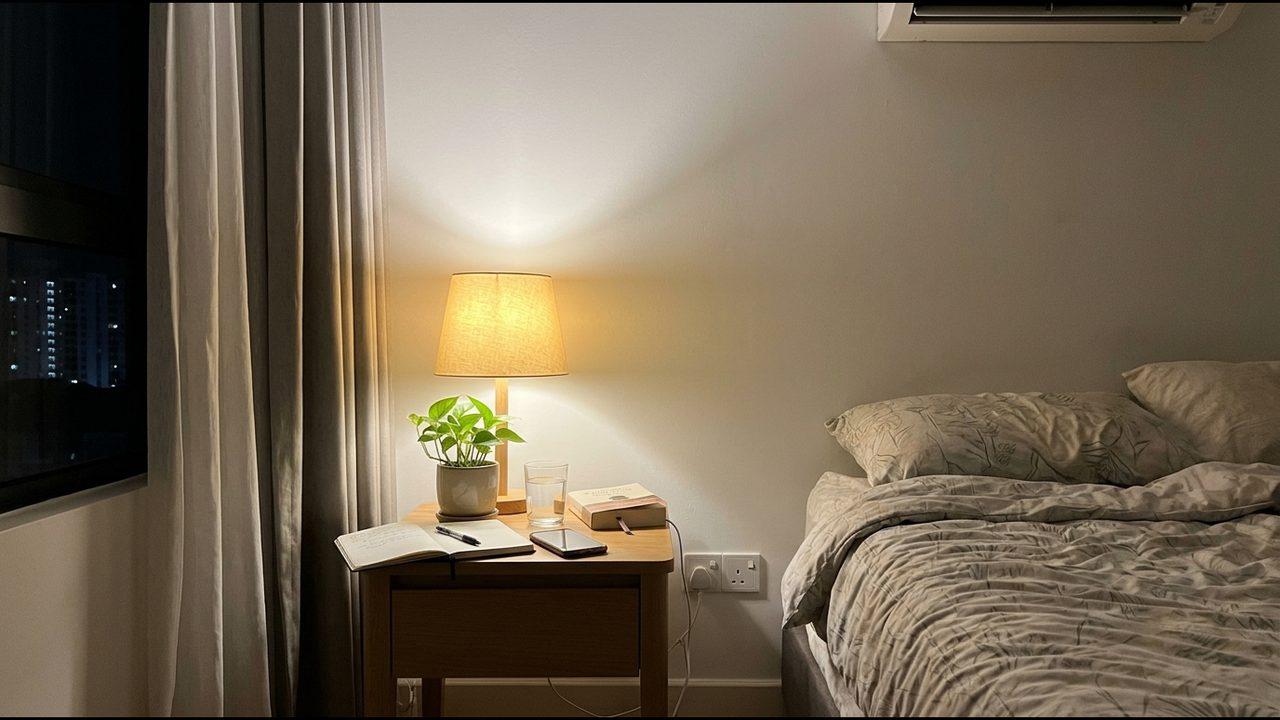
It's 10:00 pm. Your body is exhausted, and all you want is a good night's rest. You've spent the day answering messages, finishing tasks and working through your to-do list.
You finally get into bed, ready to enjoy your quiet time. But your mind decides it's the time to bring up everything else.
"Why did they just reply 'OK'? Did I say something wrong?"
"Wait, why did I say that earlier? Did that sound awkward?"
"Oh no, why did I do that embarrassing thing three days ago?"
"What if I am late for work tomorrow? What if everything goes wrong?"
Before you realise, one small thought has turned into a whole story. You're replaying conversations, analysing messages and coming up with different scenarios, including situations that haven't happened yet.
You turn to the other side and tell yourself to stop thinking, only to realise that your mind is still going.
Overthinking at night can be frustrating, especially when you're already tired and just want to rest. At Safe Space Psychology Centre, we understand that overthinking can look different for everyone. What works for one might not work for another, hence finding ways to manage it can take a little time to explore.
Why do we overthink more at night?
Daily responsibilities and conversations keep our attention occupied during the day. We might put certain worries aside simply because there isn't enough time to think about them.
However, when the day slows down with fewer distractions, those concerns become more noticeable. An upcoming presentation, an unresolved disagreement or a reminder of an unfinished task might suddenly come to your mind.
You might start wondering, "What if I make a mistake tomorrow?" or "Did I say something wrong during that conversation?" which is commonly described as an experience of worry and rumination.
This experience might begin with a genuine concern or a desire to understand a situation better. However, replaying them does not always bring you closer to a solution, which can leave you feeling mentally exhausted and make it harder to switch off.
Your mind gets more and more active, with thoughts and a sense of uneasiness. These unsettled thoughts give rise to physical responses, such as discomfort, muscle tension, heart beating faster or restlessness. You become physically and mentally exhausted.
As a result, falling asleep can become more difficult. You start to spiral into worrying about how little sleep you're getting or how tired you'll feel the next day, potentially adding another concern to an already busy mind.
This can become a frustrating cycle of the more you dwell on your concerns, the harder it may feel to switch off and settle down.
3 gentle steps to stop overthinking at night
If you're wondering how to stop overthinking at night, the goal isn't to force your mind to become completely quiet. You can try making small adjustments that will help to work through your concerns or bring your attention back to the present.
Give your thoughts somewhere to go
If your mind keeps reminding you about unfinished tasks or unresolved concerns, try writing them down earlier in the evening, preferably before getting into bed.
You can use a notebook, or a piece of paper on the side of your bed. Divide the page into two columns:
| What's on your mind? | What's my next step |
|---|---|
| I haven't finished my annual report | Make a to-do list right now. Call XX tomorrow to get the figures |
| I need to reply to unanswered emails or messages | Reply tomorrow at 10 am |
| I'm worried about an upcoming presentation | Take 15 minutes tomorrow to review the slides |
The left column focuses on the potential worries that keep you overthinking at night, whereas the right column helps you identify manageable next steps. Your next step doesn't have to solve the entire problem.
Not everything can be sorted out in one evening; some things take time. For now, you can focus on what you can realistically do next. Identifying your concerns and planning manageable actions before the night kicks in is an approach in cognitive behavioural therapy (CBT) to make things less overwhelming.
The app on your smartphone may do the same work. However, nighttime use of smartphones is one of the easiest gateways to doomscrolling and distractions, and can further worsen the quality of your night.

Slow things down with the 4-7-8 breathing technique
When your mind has been taken over by overthinking, the 4-7-8 breathing technique helps you feel calm, centered, and safe.
You don't need any special equipment. Find a comfortable position, but sitting upright with your back straight. Exhale completely through your mouth, making a "whoosh" sound.
- Inhale: Close your lips and breathe in quietly through your nose for a mental count of four.
- Hold: Hold your breath gently for a count of seven.
- Exhale: Slowly breathe out through your mouth for a count of eight, making a soft "whoosh" sound.
- Repeat: This completes one cycle. Repeat for three more cycles, making four breaths in total.
You don't need to force yourself to follow the counts if they feel uncomfortable. Start gently, and return to your normal breathing if you feel dizzy or uncomfortable. You can gradually become more comfortable with the rhythm through practice.
You can think of it as giving yourself a small pause. Simply allow yourself to experience the breath, take a moment to slow down.
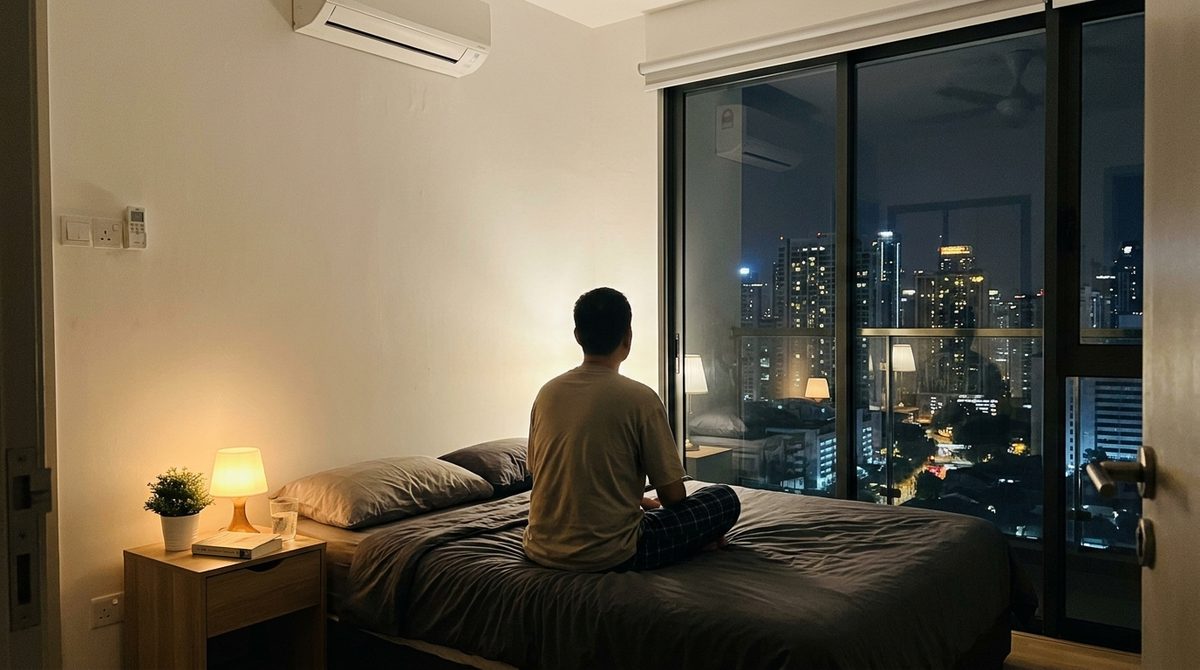
Bring yourself back to the present with the 5-4-3-2-1 technique
Sometimes, your thoughts move between past conversations and imagined future problems, making it difficult to stay in the present moment. A grounding exercise might guide you to reconnect with what's already around you.
The 5-4-3-2-1 grounding technique uses your five senses to guide your attention back to the present:
- 5 things you can see: Look around you and mentally note five things you can see, such as the curtains, shadows, ceiling light or a pen on the desk. Notice their colours, shapes and details.
- 4 things you can hear: Shift your senses and list four sounds you can hear, such as the fan humming or traffic outside. Think about the volume of the sounds.
- 3 things you can touch: Bring your attention closer to different things you can touch, including the texture of your blanket and the fabric of your clothes. Notice whether they feel soft, rough, smooth, cold or warm.
- 2 things you can smell: Tune into your nose and find two things you can actively smell, such as the smell of a pillow or the shampoo in your hair.
- 1 thing you can taste: Finally, bring your awareness to what you can taste in your mouth. It could be the lingering toothpaste or water.
You don't need to find anything special for each sense; simply notice what's already there in your current environment.
If your mind wanders, that's okay. Gently bring your attention back to the present moment without judging yourself. There is no right or wrong way to use this method; you are noticing yourself in a safe space.
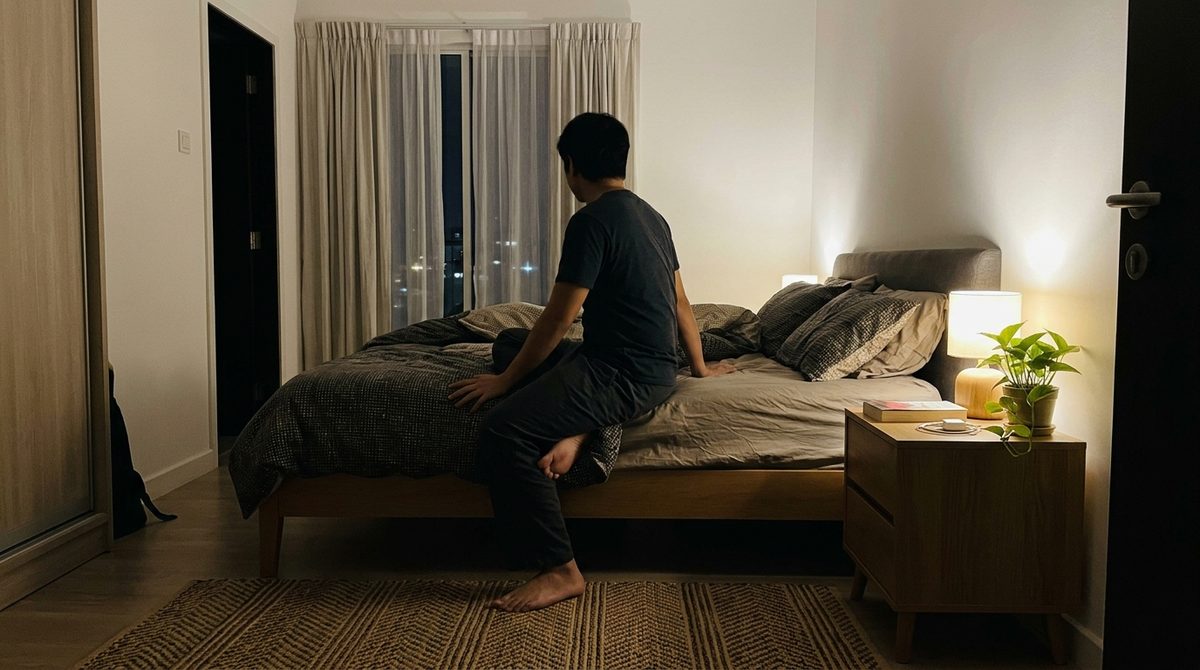
You don't have to get everything right or use every technique at once. What matters is finding approaches that feel helpful and realistic for you. At Safe Space Psychology Centre, we believe in taking small and manageable steps. A little space to pause is already a good place to start.
When is it time to talk to someone?
Occasional overthinking is a common experience, and sometimes a few simple coping strategies might be enough to help you manage it.
For example, if you're feeling nervous about an upcoming presentation, writing down your concerns and preparing practical next steps might help. You can also try grounding techniques or breathing exercises to help wind down.
If a concern keeps weighing on you, sharing it with a trusted friend or family member might offer a different perspective. You don't necessarily need them to solve the problem. Sometimes, the goal isn't to get an immediate solution, but to feel heard and less alone.
However, if overthinking repeatedly disrupts your sleep, leaves you exhausted during the day or starts to affect your daily routine, including struggling to concentrate at work or school, you might want to consider speaking with a psychologist, counsellor or other qualified mental health professional.
Our counsellors or psychologists at Safe Space Psychology Centre could help you by identifying or exploring what's on your mind, understanding the possible factors contributing to your overthinking, and developing personalised strategies suited to your circumstances.
An initial conversation might involve discussing when overthinking tends to happen, how it affects your sleep and daily life, and what you've already tried. You don't need to have everything figured out before reaching out, nor wait until things feel unbearable.
If you'd like to explore your options, you can visit our Team page on our website to learn more about our therapists and find someone whose experience and approach might be a good fit for you. You can also visit our Vibe Check if you'd like some help finding someone who may suit your needs.
You don't have to figure everything out tonight
Some thoughts may still be there when you close your eyes, and that's alright. Rest doesn't have to wait until every concern has been resolved.
You can start by acknowledging a concern without solving it immediately, writing down something to revisit tomorrow, taking a few deep breaths or gently bringing your attention back to the present.
Be patient with yourself by allowing yourself to learn how to respond to overthinking; even small steps towards looking after yourself matter.
If you're unsure where to start, send us a WhatsApp message at +6018 959 9018 to share your concerns or enquire about our counselling and psychological support services. Our team will be happy to guide you through the available options.
Give yourself the permission to thrive. Start a conversation with Safe Space today.
FAQ
Why do we overthink more at night?
During the day, responsibilities and conversations keep our attention occupied, so we might put worries aside. When the day slows down with fewer distractions, those concerns become more noticeable — an upcoming presentation, an unresolved disagreement, or an unfinished task. Replaying them does not always bring you closer to a solution, which can leave you mentally exhausted and make it harder to switch off.
What are some gentle ways to ease overthinking at night?
You don't have to force your mind completely quiet. You can try writing concerns down earlier in the evening with a manageable next step, slowing down with the 4-7-8 breathing technique, or bringing your attention back to the present with the 5-4-3-2-1 grounding technique. You don't have to use every technique at once; what matters is finding approaches that feel helpful and realistic for you.
When should I talk to someone about overthinking?
Occasional overthinking is common, and simple coping strategies or talking with a trusted friend or family member might be enough. If overthinking repeatedly disrupts your sleep, leaves you exhausted during the day, or starts to affect your daily routine — including struggling to concentrate at work or school — you might want to consider speaking with a psychologist, counsellor or other qualified mental health professional.
Do I need to have everything figured out before I reach out?
No. You don't need to have everything figured out before reaching out, nor wait until things feel unbearable. You can visit our team page to learn more about our therapists, use Vibe Check if you'd like help finding someone who may suit your needs, or book a free 15-minute call.
When you're ready
You don't have to figure everything out tonight. A sentence about what's been on your mind is enough to begin, and you can also reach us on WhatsApp from the booking page.
- Book your free 15-minute call
- See how therapy works
- Check our fees
- Meet our team
Need help right now? We're not a crisis service. Call 999, Befrienders KL 03-7627 2929 or Talian Kasih 15999.
Written by Jing Yi Ong, Psychology Intern. Reviewed by Cheng Kah Hoe, Senior Clinical Psychologist.
References
Aktaş, G. K., & İlgin, V. E. (2022). The effect of deep breathing exercise and 4–7-8 breathing techniques applied to patients after bariatric surgery on anxiety and quality of life. Obesity Surgery, 33(3). https://doi.org/10.1007/s11695-022-06405-1
Carney, C. E., & Edinger, J. D. (2010). Cognitive strategies for managing anxiety and insomnia. Insomnia and Anxiety, 109–122. https://doi.org/10.1007/978-1-4419-1434-7_8
Hiller, R. M., Lovato, N., Gradisar, M., Oliver, M., & Slater, A. (2014). Trying to fall asleep while catastrophising: What sleep-disordered adolescents think and feel. Sleep Medicine, 15(1), 96–103. https://doi.org/10.1016/j.sleep.2013.09.014
Huang, N. N., Moulds, M. L., Newby, J. M., & Werner-Seidler, A. (2025). Repetitive negative thinking in adolescence: A mixed methods study. Child and Adolescent Psychiatry and Mental Health, 20(1), Article 5. https://doi.org/10.1186/s13034-025-01005-0
Joubert, A. E., Moulds, M. L., Werner-Seidler, A., Sharrock, M., Popovic, B., & Newby, J. M. (2022). Understanding the experience of rumination and worry: A descriptive qualitative survey study. British Journal of Clinical Psychology, 61(4). https://doi.org/10.1111/bjc.12367
Moon, L. (2023). How to stop overthinking: 27 Proven ways to rewire your anxious brain, calm your thoughts, stop worrying, and be happy. Layla Moon. https://books.google.com/books?id=r3DLEAAAQBAJ
NHS. (2022). Exploring mindfulness and the 5-4-3-2-1 grounding activity. Lincolnshire Young Minds. https://www.lpft.nhs.uk/young-people/lincolnshire/about-us/whats-new/grounding-activity
Puccetti, N. A., Stamatis, C. A., Timpano, K. R., & Heller, A. S. (2024). Worry and rumination elicit similar neural representations: Neuroimaging evidence for repetitive negative thinking. Cognitive, Affective, & Behavioral Neuroscience, 25(2), 488–500. https://doi.org/10.3758/s13415-024-01239-z
Vîslă, A., Stadelmann, C., Watkins, E., Zinbarg, R. E., & Flückiger, C. (2022). The relation between worry and mental health in nonclinical population and individuals with anxiety and depressive disorders: A meta-analysis. Cognitive Therapy and Research, 46. https://doi.org/10.1007/s10608-021-10288-4
You, Z., Li, X., Ye, N., & Zhang, L. (2021). Understanding the effect of rumination on sleep quality: A mediation model of negative affect and bedtime procrastination. Current Psychology, 42(1), 136–144. https://doi.org/10.1007/s12144-020-01337-4
About the editorial team
Each article names who wrote it and who reviewed it.
Jing Yi Ong
Psychology Intern